Most tools that help teams document processes do one thing well. They create diagrams. Or they create documents. Or, if they are particularly capable, they help teams do both — but in separate workflows, with separate inputs, and with the ongoing challenge of keeping the two aligned as processes change.
FlowcastGPT's new feature set changes the scope of what a process documentation tool can do — not incrementally, but categorically.
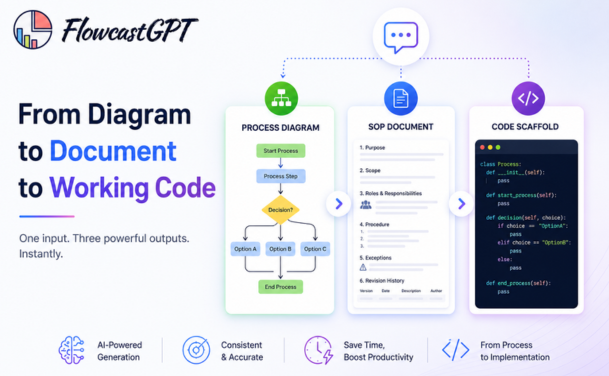
From a single natural language description of a process, FlowcastGPT now generates three distinct, professionally structured outputs simultaneously: a colour-coded visual process diagram, a fully formatted Standard Operating Procedure document complete with roles, exceptions, and revision history, and — most significantly — a code scaffold that implements the process logic in working code, ready to be extended and deployed.
This is not three separate features that happen to be available in the same tool. It is a single generation that produces all three — diagram, document, and code — from one input, at the same time, fully consistent with each other.
This blog covers every new feature in detail: what each one does, what it produces, what problem it solves, and what teams can realistically accomplish with it. It also explores the code scaffolding capability — the most significant new addition and the one that extends FlowcastGPT from a documentation tool into the space where documentation and software development meet.
Read: Creating SOPs Faster Using AI-Generated Flowcharts
The central capability that all other features build upon is simultaneous multi-format generation. Where previous generations of process documentation tools required separate workflows for visual and written documentation, FlowcastGPT generates all outputs from one generation event — and keeps them structurally aligned because they share the same underlying process model.
The three outputs are:
A structured, colour-coded flowchart using industry-standard diagramming conventions — green rounded nodes for start and end points, blue rectangular boxes for process steps, yellow diamond nodes for decision points, and labelled directional arrows for each process path. The diagram is production-ready: clear, logically structured, and appropriate for presentations, training materials, wikis, and governance documentation.
A complete, professionally formatted written procedure that mirrors the diagram exactly — with document metadata, purpose statement, scope definition, role assignments, numbered procedure steps, exception handling, revision history, and appendix. The document is immediately suitable for document management systems, compliance frameworks, and quality management processes.
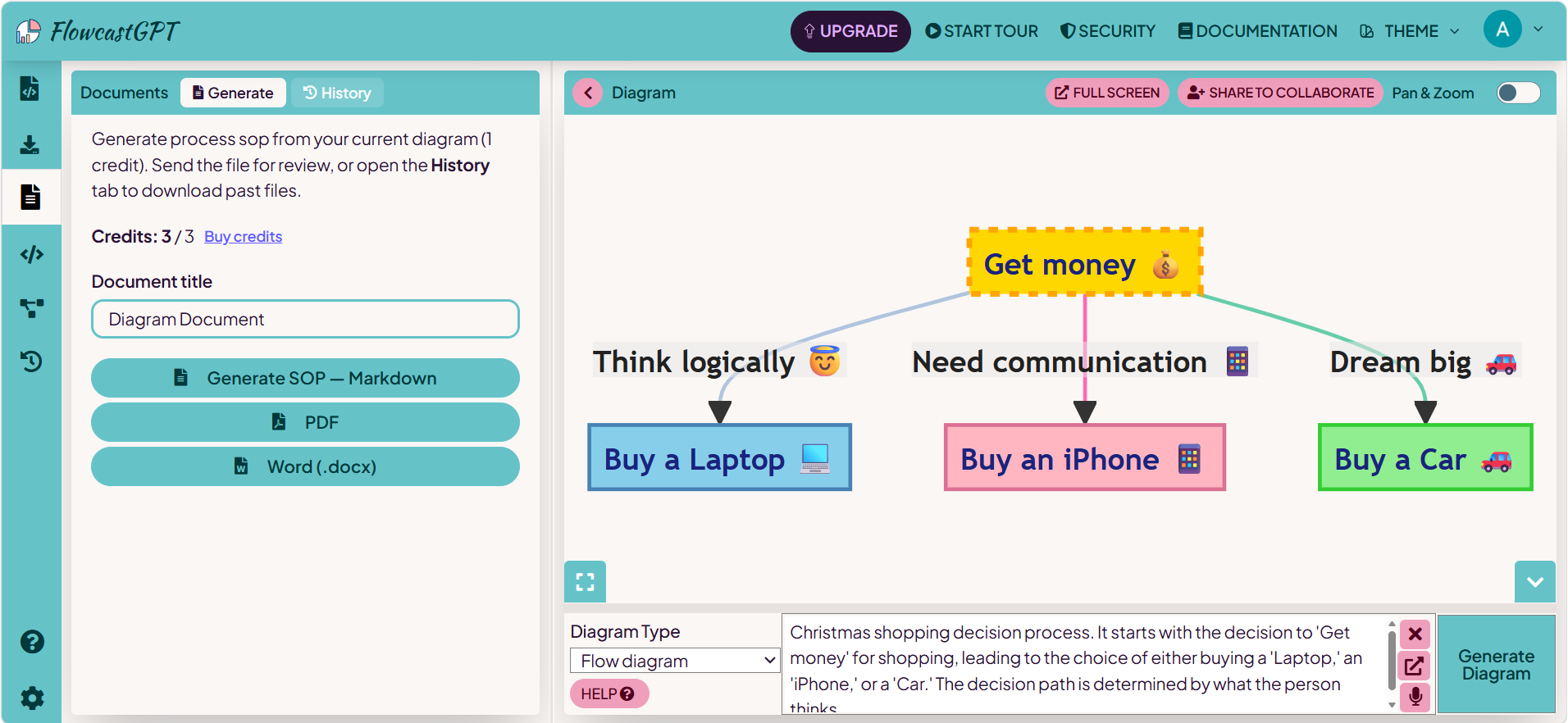
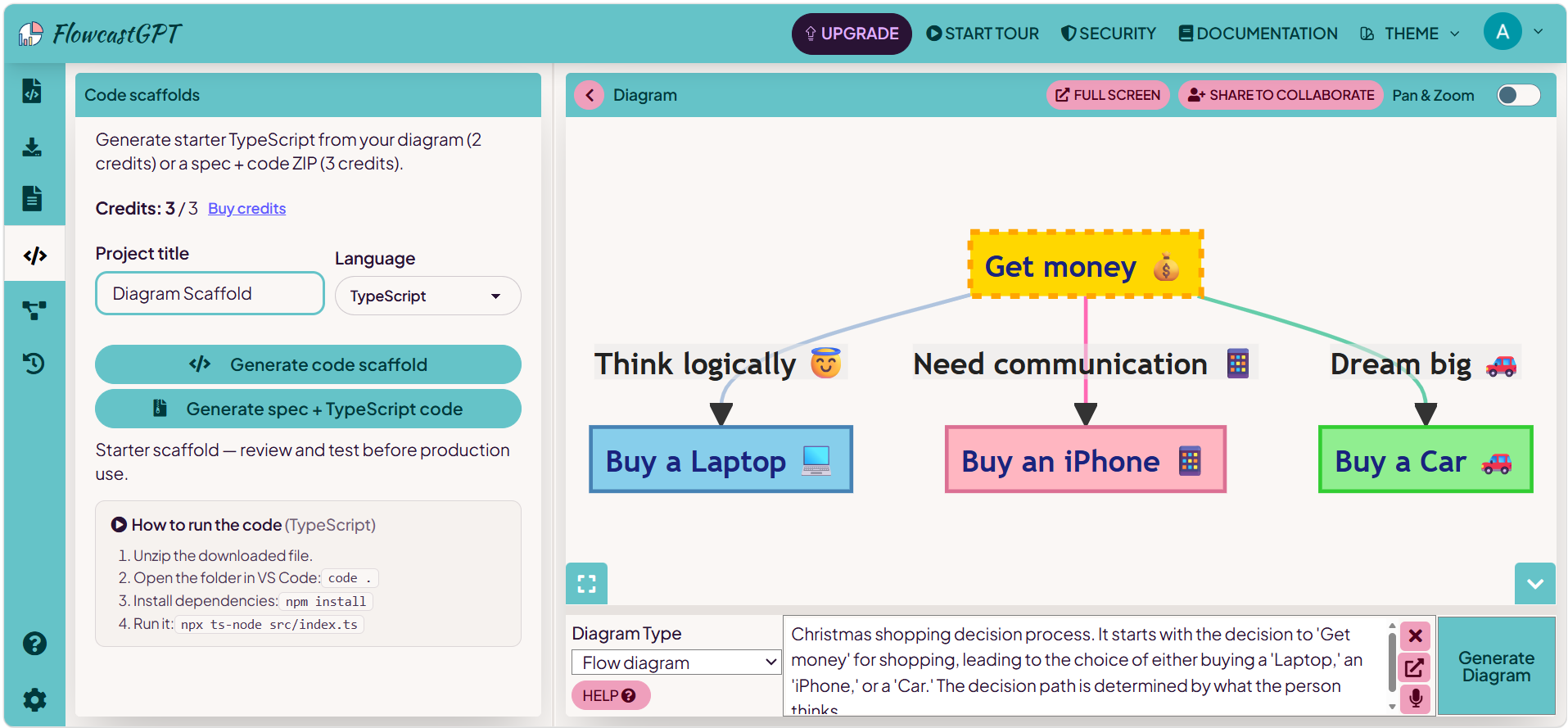
The newest and most powerful addition: working code that implements the process logic captured in the diagram. From the same input that generates the diagram and document, FlowcastGPT generates a code scaffold — the structural skeleton of the program that implements the process, with the logic, branching, and role-based responsibilities of the process translated into code that a developer can extend, customise, and deploy.
Each of these three outputs is explored in detail below.
The foundation of FlowcastGPT's new output is a professional visual process diagram generated automatically from natural language input.
The diagram produced uses the standardised visual language of professional process documentation:
Green rounded terminal nodes mark the start and end points of the process — the entry and exit nodes that frame the entire workflow and are immediately identifiable as the boundaries of the process.
Blue rectangular process boxes represent the action steps — the discrete tasks that must be performed at each stage of the process. Each box is labelled with a clear, concise action description.
Yellow diamond decision nodes represent the branching points — the moments in the process where a choice must be made and the flow diverges into multiple paths based on the outcome of that choice. The decision node contains the question being decided.
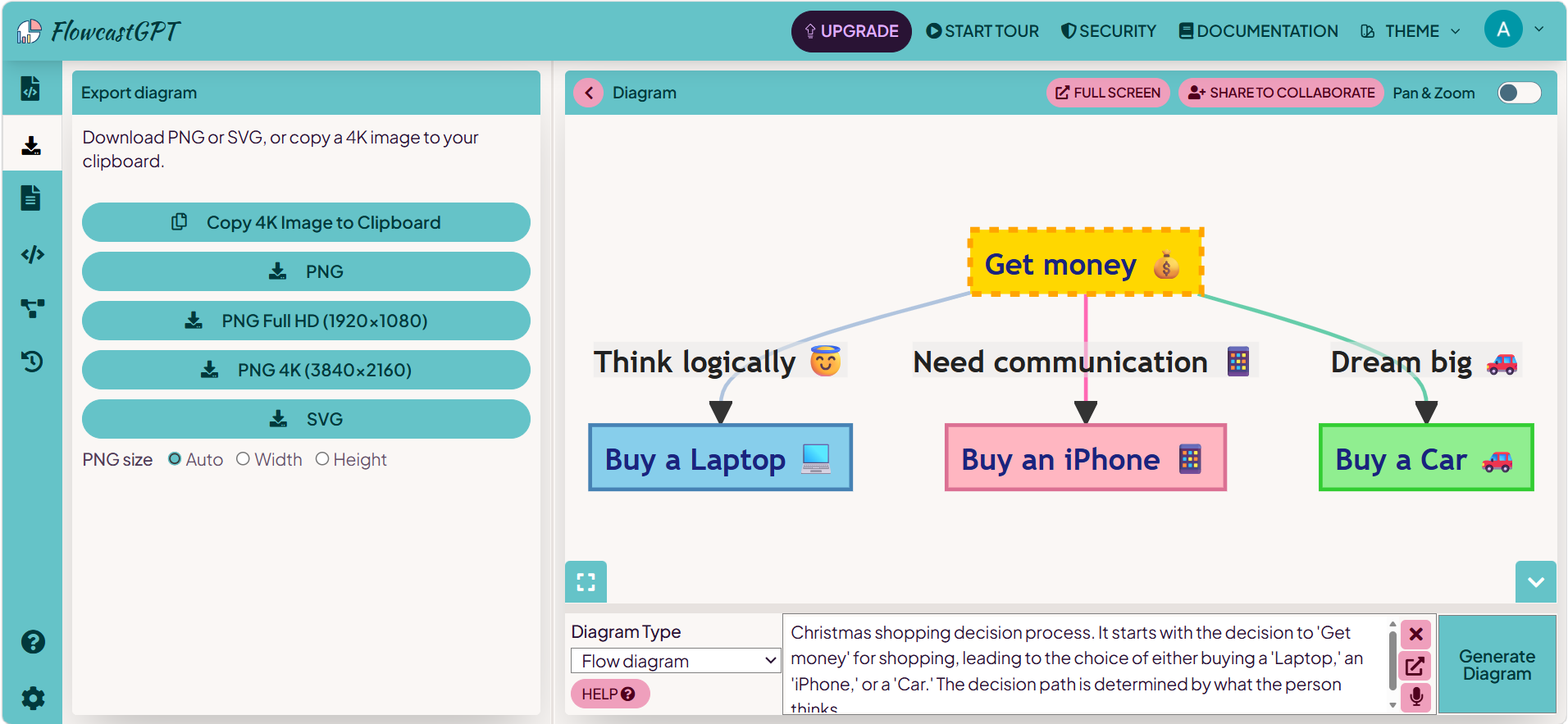
Labelled directional arrows connect the nodes and indicate the conditions or choices that direct flow along each path. For decision nodes with multiple branches, each arrow is labelled with the branch condition — for example, "Laptop," "iPhone," or "Car" — so that the diagram is self-explanatory without requiring reference to accompanying text.
The convergence logic is also captured correctly: all branches from a decision node that lead to the same downstream step are shown converging back to that node, maintaining the accurate visual representation of process structure rather than artificially linearising a non-linear flow.
The result is a diagram that meets the standard of a professionally produced flowchart — without requiring any manual work in a diagramming tool.
The first and most immediately impactful new capability for documentation teams is what happens at the same time as the diagram is generated.
FlowcastGPT produces a fully structured SOP document that mirrors the diagram completely — not as a description of the diagram, but as a parallel structured artifact that represents the same process in written, navigable, document-management-ready form.
The generated document contains the following sections, all populated automatically from the process input:
Document Metadata
Document ID, version number, date, and owner are generated as structured metadata — making the document immediately compatible with document management systems, version control workflows, and compliance audit requirements.
Purpose Statement
A clearly worded explanation of what the procedure is designed to achieve and what structured approach it establishes.
Scope Definition
A precise statement of who the procedure applies to, which functions or departments it covers, and what the procedure encompasses from start to completion.
Roles Section
Every role involved in the process is named and defined — with a clear statement of each role's specific responsibility within the procedure. In the generated example, two roles are defined: the Procurement Officer, responsible for initiating the process and making purchasing decisions, and the Finance Officer, responsible for ensuring the availability of funds.
Numbered Procedure Steps
Each step in the process is documented as a numbered item with the responsible role identified. The procedure steps mirror the flowchart exactly — every node in the diagram corresponds to a step in the written procedure, in the same sequence, with consistent naming and action description.
Exceptions Section
The conditions under which the standard procedure does not apply are documented automatically — including what should happen in each exceptional case. This is one of the most difficult sections of any SOP to write comprehensively, and one of the most important for operational resilience. FlowcastGPT generates it from the process structure without requiring it to be specified separately.
Revision History Table
A structured table tracking document version, date, description of changes, and author — automatically populated for the initial version and structured to accommodate future updates. This makes the generated document immediately compliant with the revision tracking requirements of quality management systems and regulatory frameworks.
Appendix
A reference section linking the written procedure back to the source diagram, maintaining traceability between the visual and written representations of the process.
The practical significance of this dual-output capability is most clear when compared to conventional workflows: producing both a diagram and a structured SOP manually, across separate tools, typically requires four to eight hours of work from two or three people with different skills. FlowcastGPT produces both in seconds — fully consistent, fully aligned, ready for human review.
The most powerful and strategically significant new feature in FlowcastGPT is one that extends the platform from a documentation tool into the space where documentation and software development meet: code scaffolding.
From the same input that generates the diagram and the SOP document, FlowcastGPT can now generate a code scaffold — a structured, working code skeleton that implements the process logic captured in the diagram.
A code scaffold is the structural skeleton of a program that implements a defined process. It is not a rough outline or pseudocode. It is working code — with the correct structure, logic flow, branching, and function signatures — that a developer can immediately extend, customise, and build upon without starting from a blank file.
For a process as illustrated in the FlowcastGPT example — a decision-branching procurement process with a start node, a preparatory step, a multi-branch decision, three possible action paths, and an end node — the code scaffold would implement:
The scaffold compiles and runs. It does not have business logic — the developer adds that. But the structure is correct, the flow is accurate, and the exception handling mirrors what the process document specifies. The developer's starting point is not a blank file but a working implementation of the process architecture.
The significance of code scaffolding extends well beyond the time it saves on initial setup.
It closes the gap between process design and implementation. In most software development workflows, there is a meaningful translation gap between a process diagram and its software implementation. A business analyst creates the diagram. A developer reads it and writes code from it — introducing the risk of interpretation errors, missed branches, and exception handling that does not match the specified behaviour. Code scaffolding eliminates this translation layer: the process definition is the code specification, and the scaffold implements it directly.
It accelerates onboarding and handoff. When a process is handed from a process designer to a development team, a code scaffold makes the handoff immediately actionable. The developer receives not just a diagram to interpret but a working code structure to extend. The cognitive distance between "what the process requires" and "what the code should do" is dramatically reduced.
It enforces consistency between documentation and implementation. One of the most persistent maintenance challenges in software-backed processes is the divergence between documented behaviour and implemented behaviour. When both the documentation and the initial code are generated from the same source, they are structurally consistent at the point of creation. Subsequent divergence is a deliberate choice — not an accidental consequence of maintaining two separate artifacts.
It makes process design immediately accessible to developers. Developers who work primarily in code often find visual process diagrams a useful communication tool but a frustrating starting point for implementation. A code scaffold translates the visual artifact into their native medium — giving them a code structure that implements the diagram, rather than a diagram they must translate into code.
Based on FlowcastGPT's process model, the generated code scaffold covers:
FlowcastGPT's role assignment capability operates across all three output types — diagram, document, and code — ensuring that responsibility is consistently represented wherever the process is expressed.
In the diagram, roles are indicated through labelling conventions that make ownership visible without cluttering the visual flow. In the SOP document, each step carries an explicit "Role Responsible" tag — as seen in the generated example, where the Finance Officer is responsible for Step 2 (securing funds) and the Procurement Officer is responsible for all remaining steps. In the code scaffold, role attribution is reflected in the structure and annotation of the generated code.
This cross-format consistency means that anyone consuming any of the three outputs — a manager reviewing the diagram, a new team member reading the SOP, a developer extending the code scaffold — sees the same role assignments, expressed appropriately for their medium.
The decision node in FlowcastGPT's diagram generation is not limited to binary yes/no choices. The platform models multi-branch decision logic — where a single decision point produces three or more possible paths — accurately in both the visual and written outputs.
In the generated example, the "What to buy?" decision node branches into three separate paths: Laptop, iPhone, and Car. Each branch leads to a distinct action step. All three branches converge back to the End Shopping terminal node. This structure is accurately represented in the diagram with three labelled outgoing arrows from the diamond node, and in the SOP document with three conditional procedure steps — "Buy a Laptop (if chosen)," "Buy an iPhone (if chosen)," "Buy a Car (if chosen)."
In the code scaffold, this multi-branch decision becomes a multi-path conditional structure — whether an if/elif/else chain, a switch statement, or a routing function — with each branch implementing the corresponding action.
The ability to model multi-branch decision logic accurately across all three output formats is particularly valuable for complex business processes — approval workflows with multiple outcome paths, customer service routing trees, procurement decision frameworks, and compliance decision matrices.
Most process documentation tools generate the standard path through a process clearly and handle exceptions as an afterthought — or not at all. FlowcastGPT treats exception handling as a first-class element of the process model, generating exception documentation in both the SOP document and the code scaffold.
In the SOP document, the Exceptions section documents the conditions under which the standard process does not apply and the alternative action that should be taken. The generated example documents two exceptions: the case where funds are not available (process pauses until the Finance Officer secures budget) and the case where the selected item is unavailable (Procurement Officer reassesses and selects an alternative).
In the code scaffold, these same exceptions become structured error handling blocks — the conditions that trigger them are implemented as exception checks, and the alternative actions are implemented as the exception handlers.
This parallel exception modelling across documentation and code is one of the most practically significant capabilities in the new feature set. Exception handling is simultaneously one of the most important elements of any production process and one of the most consistently under-documented and inconsistently implemented. By generating exception handling from the same source as the standard path, FlowcastGPT ensures that exceptions are neither overlooked in documentation nor missed in implementation.
The generated SOP document includes a Revision History table in the initial output — not as a section to be filled in later, but as a structured, populated table that tracks version, date, description, and author from the first generation.
This matters for compliance, quality management, and governance workflows that require documented evidence of a procedure's provenance. A document generated by FlowcastGPT is immediately compliant with document versioning requirements — it carries its version history from the first iteration.
As processes evolve and documents are updated, the revision history provides a clear and structured audit trail. Combined with the ability to regenerate all three outputs from an updated process description, FlowcastGPT makes process maintenance significantly more manageable than it is with manually maintained documentation.
Every document generated by FlowcastGPT carries a "Draft — review before publication" status in its header. This is a deliberate and important design decision that reflects the appropriate role of AI in process documentation.
AI-generated process artifacts — whether diagrams, documents, or code scaffolds — are first drafts. They are high-quality, structurally accurate starting points that dramatically accelerate the documentation process. They are not substitutes for the human review, validation, and approval that determines whether a process document is ready to govern actual operations or whether a code scaffold is ready to be built upon.
The draft status embeds a human-in-the-loop requirement directly into the generated artifact. It signals to anyone receiving the document that review is expected before the content is treated as authoritative — without requiring a separate instruction or communication to convey that expectation.
For organisations with formal document approval processes — quality management sign-off, legal review, technical architecture review — the draft status integrates naturally into those workflows. The FlowcastGPT-generated artifact enters the same review and approval cycle as any manually produced draft, with the significant difference that the draft was produced in seconds rather than hours.
Also read: AI Workflow Visualization for Digital Transformation Projects - Complete Guide
The most important thing to understand about FlowcastGPT's new feature set is not any individual feature — it is the compound effect of all three outputs being generated simultaneously, from a single input, fully consistent with each other.
In conventional workflows:
In FlowcastGPT's new workflow:
The process description is the single source of truth. The diagram, document, and code scaffold are all generated from it simultaneously. When the process changes, the description is updated and all three outputs are regenerated. Consistency is maintained structurally, not through manual coordination.
The shift from three separate artifacts maintained manually to three aligned outputs generated from one source is not just an efficiency gain. It is a change in the fundamental reliability of process documentation — because consistency between documentation and implementation is no longer dependent on human coordination across workflows. It is guaranteed by the generation process itself.
Check out: How to Convert Requirements Documents into Visual Diagrams Using AI
Operations and process management teams gain the ability to produce complete process documentation packages — visual, written, and implementable — at the pace of process design rather than weeks or months later. Process changes can be documented comprehensively in the time it takes to update the description and regenerate.
Software development teams gain a code scaffold that implements the process logic from the diagram — eliminating the translation step between process design and code architecture, reducing interpretation errors, and giving developers a working structure to extend rather than a blank file to fill.
Business analysts and product managers gain the ability to produce documentation artifacts that span the full range of their stakeholders' needs — visual diagrams for executive communication, structured SOPs for operations, and code scaffolds for engineering — without requiring separate tools, separate workflows, or specialist expertise in any of them.
Compliance and governance teams gain SOP documents that are immediately structured for compliance requirements — with version control, role assignments, exception handling, and revision history generated automatically in the initial output.
Consultants and professional services firms gain the ability to produce complete process documentation deliverables — including implementation-ready code scaffolds — at a fraction of the time previously required, enabling more time for the higher-value analysis and advisory work that documentation supports.
Also check: AI Diagram Generator: The Complete Guide for Teams and Enterprises
FlowcastGPT's new feature set — simultaneous diagram, document, and code scaffold generation from a single input — represents a meaningful advancement in what a process documentation tool can do.
The individual features are each valuable: professional diagram generation, role-based process modelling, multi-branch decision logic, exception handling documentation, version control, and draft-status publication workflow. But the compound capability they enable together is greater than the sum of its parts.
For the first time, the process description becomes the single source of truth from which all downstream artifacts — visual, written, and executable — are generated simultaneously. The gap between process design and process implementation is narrowed to the width of a single generation event.
That is not an incremental improvement to how process documentation has worked for the past decade. It is a structural change in what process documentation is capable of — and what it can mean for the teams that depend on it.
Experience FlowcastGPT's new features firsthand. Generate your first diagram, document, and code scaffold from a single process description — in seconds.