Technical documentation has evolved far beyond static Word documents and lengthy PDFs. Modern software teams need documentation that is visual, collaborative, easy to update, and closely aligned with rapidly changing systems.
Whether you're documenting software architecture, cloud infrastructure, APIs, workflows, or business processes, diagrams have become an essential part of technical communication.
The challenge?
Creating and maintaining diagrams manually is often slow, repetitive, and difficult to keep synchronized with evolving projects.
That's why AI-powered diagram generators have become one of the fastest-growing productivity tools for developers, architects, DevOps engineers, and technical writers.
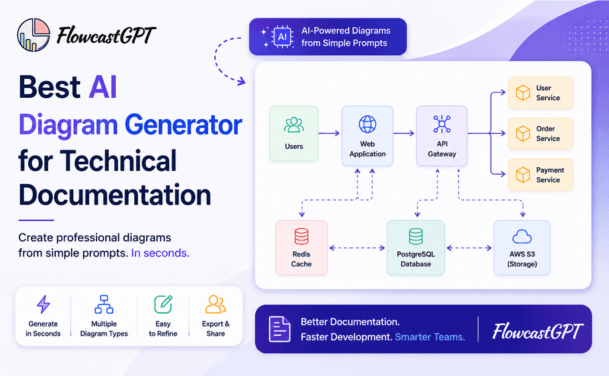
Instead of spending hours dragging shapes, connecting arrows, and updating diagrams, AI allows teams to generate professional technical diagrams from simple natural language prompts, documentation, or requirements.
In this guide, we'll explore the best AI diagram generators available in 2026, what features matter most, and why FlowcastGPT is becoming a preferred choice for technical documentation.
Not all AI diagram tools are created equal — and in 2026, the market includes both genuinely powerful engineering tools and surface-level "AI-labeled" products that produce impressive-looking output without the technical accuracy or workflow integration that serious documentation requires.
Before comparing specific tools, the criteria that differentiate genuinely useful AI diagram generators from impressive demos are:
Technical documentation demands precision. A system architecture diagram with incorrect routing, a process flowchart with broken logic, or a UML class diagram with wrong relationships is worse than no diagram — it actively misleads the teams that rely on it. The best AI diagram generators understand technical vocabulary, common software architecture patterns, and domain-specific notation.
Technical documentation requires many different diagram types: flowcharts for process documentation, UML diagrams for software architecture, ER diagrams for database schemas, sequence diagrams for API interactions, C4 diagrams for system architecture at different abstraction levels, swimlane diagrams for cross-functional processes, and decision trees for business logic. The most useful tools cover the full range.
The most capable tools in 2026 go beyond diagram generation to produce structured documentation alongside the visual — procedure documents, SOP files, code scaffolds, or technical specifications that mirror the diagram content. This dual output is where the most significant productivity gains over single-output diagram tools are found.
Prompt-to-diagram generation is the starting point, not the ending point. The best tools provide a natural editing experience — canvas editing, iterative refinement through follow-up prompts, and the ability to customise styling, layout, and content without rebuilding from scratch.
For technical teams, diagram tools that live in isolation from where work actually happens add friction rather than remove it. Integration with GitHub, Confluence, Notion, VS Code, and other documentation and development platforms determines whether diagrams stay current or become immediately outdated.
Technical documentation is rarely produced by one person. Real-time collaboration, commenting, version history, and team sharing are baseline requirements for enterprise technical documentation workflows.
SVG for scalable web embedding, PNG for documentation platforms, PDF for formal documentation deliverables, and where relevant, Mermaid or draw.io format for diagram-as-code workflows. Format flexibility determines where and how diagrams can be used.
Read: AI Workflow Visualization for Digital Transformation Projects - Complete Guide
Traditional diagramming tools require:
AI eliminates much of this effort.
Instead of drawing diagrams, developers describe systems using plain English.
The AI handles:
This significantly reduces documentation time.
| Tool | Best For | Diagram Types | Key Differentiator |
|---|---|---|---|
| FlowcastGPT | Process documentation + SOP generation | Flowcharts, decision trees, swimlanes, process maps | Simultaneous diagram + structured SOP document output |
| Eraser / DiagramGPT | Engineering architecture documentation | Architecture, ER, sequence, flowcharts | Developer-native; GitHub + VS Code integration |
| Lucidchart AI | Enterprise documentation at scale | Full diagram suite (50+ types) | MCP server for LLM-driven creation (Nov 2025) |
| InfraSketch | Software architecture diagrams | Architecture, C4, microservices | Claude AI-powered; purpose-built for architects |
| Whimsical AI | Product and process flowcharts | Flowcharts, mind maps, wireframes | Clean minimal output; fast generation |
| ConceptViz | Comprehensive diagram type coverage | 50+ diagram types including UML, ER, electrical | Widest diagram type support |
| Mermaid / Mermaid AI | Developer documentation workflows | Flowcharts, sequence, Gantt, class, ER | Diagram-as-code; embed in any markdown |
| Creately AI | Team collaboration across diagram types | Multiple diagram formats | Data-linked canvas; real-time team editing |
| Excalidraw AI | Rapid individual documentation | Flowcharts, architecture, process | Hand-drawn aesthetic; Mermaid integration |
| DrawIO (DiagramsNet) | Simple professional documentation | Full diagram suite | Completely free; offline capable |
Also read: FlowcastGPT New Features - Generate Process Documents & Code Scaffolding with AI Capabilities
Overview
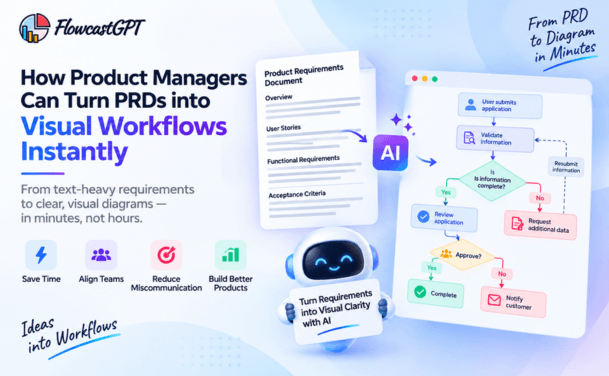
FlowcastGPT occupies a unique and highly valuable position in the 2026 AI diagram market: it is the only major tool that simultaneously generates a professional visual process diagram and a fully structured Standard Operating Procedure (SOP) document from a single natural language input.
Where most AI diagram generators produce one output — the visual — FlowcastGPT produces three: a colour-coded flowchart using professional diagramming conventions, a formatted SOP document complete with metadata, roles, numbered procedure steps, exceptions, and revision history, and a code scaffold that implements the process logic in working code ready for a developer to extend.
This triple-output capability addresses the most persistent problem in process documentation: the gap between the visual representation and the written documentation that should accompany it. In conventional workflows, producing a process flowchart and its accompanying SOP document requires separate tools, separate authoring effort, and continuous manual synchronisation as processes evolve. FlowcastGPT generates both from one description, fully aligned, in seconds.
Core Capabilities
Who It Is Best For
Operations teams that need to document business processes with accompanying written procedures. QA and compliance teams working in environments where SOP documentation is a regulatory requirement. Software development teams that want to bridge the gap between process design and implementation through code scaffolding. Business analysts producing documentation for cross-functional stakeholders who need both a visual and a written process reference. Consultants and professional services firms that produce process documentation as part of advisory or transformation engagements.
What Sets FlowcastGPT Apart
The simultaneous three-output generation model — diagram, document, and code from a single input — is genuinely differentiated. Other tools in this list generate excellent diagrams. None of them simultaneously generate a complete SOP document and a working code scaffold from the same description. For teams that currently use multiple tools to produce what FlowcastGPT delivers in a single generation, the time savings are substantial.
Limitations
FlowcastGPT's strength is in process documentation, business workflows, and procedure-focused diagramming. Teams whose primary requirement is software architecture diagrams, UML class diagrams for object-oriented design, or infrastructure topology diagrams may find specialist architecture-focused tools like InfraSketch or Eraser a better fit for those specific use cases.
Try FlowcastGPT: www.flowcastgpt.com
Overview
Eraser and its AI diagram generation component DiagramGPT are the strongest choices in 2026 for software engineers and architects who need AI-generated technical diagrams that stay close to the development workflow. Eraser's design philosophy is opinionated in a way that makes it valuable: it treats diagrams as documentation that belongs next to code, reviews, and engineering context — not as standalone visual artifacts.
DiagramGPT demonstrates deep understanding of complex technical language and proper logic flows. When given technical prompts, it asks highly specific follow-up questions before generating — a practice that produces technically accurate output rather than the generic-looking diagrams that less technically grounded tools produce for the same input.
Core Strengths
Best For: Software engineers and architects who want diagrams version-controlled alongside code. Teams using GitHub, Confluence, or Notion as their primary documentation environment.
Limitations: Less appropriate for non-technical documentation workflows. Smaller template library than general-purpose platforms. Most valuable for users comfortable with structured and semi-technical inputs.
Pricing: Free tier available. Team and enterprise plans on paid tiers.
Overview
Lucidchart is one of the most established diagramming platforms available, and its 2025–2026 investment in AI and LLM integration has meaningfully extended its enterprise value. The most significant development was the launch of an MCP (Model Context Protocol) server in November 2025 — enabling diagram creation directly from LLM prompts through connections to ChatGPT, Claude, Microsoft Copilot, GitHub Copilot, and Cursor. This positions Lucidchart as a diagram layer within AI-augmented development environments rather than only as a standalone tool.
Lucidchart is particularly strong in technical documentation, process mapping, and enterprise scenarios where precision, integration capabilities, and governance matter more than speed of initial generation. Its extensive template library, robust access controls, and deep integration with enterprise platforms (Salesforce, Google Workspace, Microsoft 365, Atlassian) make it the natural choice for large organisations with established documentation standards.
Core Strengths
Best For: Large enterprises managing documentation at scale across multiple teams, platforms, and geographies. Organisations with established Google Workspace, Microsoft 365, or Atlassian ecosystems.
Limitations: Full feature set requires a paid subscription. Can feel complex for simple, fast documentation needs where lighter tools are more appropriate.
Pricing: Paid plans starting from approximately $9 per user per month.
Overview
InfraSketch is purpose-built for software architecture diagrams, using Claude AI to understand system requirements and generate complete architecture diagrams from natural language descriptions. Its focus is intentionally narrow — it is not trying to be a general-purpose diagram tool — which means the quality and technical accuracy of its architecture output is high compared to tools that attempt to cover every diagram type.
The tool supports icons and notation for major cloud providers (AWS, GCP, Azure) and common infrastructure components (Kubernetes, Docker, microservices), and generates diagrams from descriptions like "Design a video streaming platform with CDN, transcoding pipeline, and recommendation engine" at a level of technical specificity that general-purpose tools struggle to match.
Core Strengths
Best For: Software architects and DevOps engineers building system architecture documentation. Teams working with cloud infrastructure who need accurate provider-specific notation.
Limitations: Narrow scope — strong for architecture, less suited for process documentation, business workflows, or non-technical diagram types.
Pricing: Free tier available with paid plans for advanced features.
Overview
Whimsical AI creates clean, minimal flowcharts from text prompts with a visual quality and layout clarity that makes it consistently appealing to product and design-adjacent teams. Its interface is deliberately minimal — low learning curve, fast onboarding — and extends beyond flowcharts to support mind maps and wireframes, making it useful across the full span of product design and early-stage process documentation.
Whimsical's AI generation prioritises simplicity and clarity over technical depth. This makes it an excellent choice for teams whose documentation audience includes non-technical stakeholders who need to understand and work with the diagrams.
Core Strengths
Best For: Startup teams and designers mapping product concepts. Non-technical teams producing process documentation for mixed audiences. Product managers documenting user journeys and feature flows.
Limitations: Less appropriate for complex multi-system technical architecture. Does not generate accompanying SOP documents or structured written output.
Pricing: Free tier available. Paid plans from approximately $10 per user per month.
Overview
ConceptViz is the most comprehensive AI diagram generator available in 2026 in terms of diagram type breadth, supporting over 50 diagram types from a single natural language input. The range spans UML class diagrams, entity relationship diagrams, Venn diagrams, electrical circuit diagrams, network topology diagrams, and system architecture diagrams — covering domains from software engineering and data modelling through electrical engineering and organisational design.
This breadth makes ConceptViz the strongest single-tool option for teams and individuals who work across multiple technical domains and need a single AI diagram tool that covers all of them.
Core Strengths
Best For: Teams working across multiple technical domains who need one tool for all diagram types. Technical writers producing documentation across software, data, and infrastructure domains.
Limitations: Breadth over depth — specialist tools like InfraSketch or Eraser provide deeper capability within their specific domains. Limited integration with development workflow tools.
Pricing: Free and paid tiers available.
Overview
Mermaid occupies a unique position in the 2026 diagram landscape: it is the open-source standard for diagram-as-code in developer documentation. Rather than a visual canvas tool, Mermaid uses a markdown-inspired text syntax to define diagrams that render in documentation platforms, GitHub READMEs, Confluence, Notion, and virtually every modern documentation environment.
Mermaid AI extends the core Mermaid syntax generation with AI assistance — enabling natural language descriptions to be converted to Mermaid diagram code, which then renders wherever Mermaid is supported. For development teams, this means diagrams that live in version control alongside the code they document, with the same PR review and change tracking workflow applied to diagrams as to code.
Core Strengths
Best For: Development teams whose primary documentation environment is GitHub, GitLab, or a Mermaid-supporting wiki. Technical writers comfortable with markdown and text-based workflows.
Limitations: Requires familiarity with Mermaid syntax for editing. Not appropriate for non-technical users who need visual canvas editing. Layout control is limited compared to canvas-based tools.
Pricing: Open source (free). Mermaid AI integration available through various third-party wrappers.
Overview
Creately is an intelligent visual workspace that bridges the gap between complex ideation and technical documentation. Its AI generates structured diagrams from text across multiple diagram formats, and its data-linked canvas functions as a visual database — enabling teams to integrate live data, attach technical specifications, and collaborate in real-time to maintain a central source of truth for infrastructure and workflows.
Creately was the first solution to implement template-based AI generation for advanced architectural diagrams, flowcharts, and system maps, and its position as a collaborative workspace rather than a standalone diagram tool makes it particularly valuable for cross-functional teams managing multiple diagram types within a shared environment.
Core Strengths
Best For: Teams managing multiple diagram types in a shared workspace. Cross-functional organisations where different roles (IT, engineering, business) collaborate on documentation within the same platform.
Limitations: More complex than lighter tools for simple, single-user documentation tasks. Full feature set requires a paid subscription.
Pricing: Free tier available. Paid plans from approximately $8 per user per month.
Overview
Excalidraw is a virtual whiteboard with AI features added to its collaborative drawing environment. Its distinctive hand-drawn aesthetic gives diagrams an approachable, sketch-like quality that suits early-stage documentation — requirements discussions, system brainstorming, and initial architecture exploration — where precision matters less than speed and clarity.
Excalidraw's integration with Mermaid syntax makes it particularly appealing for developers and technical users who want to generate diagram code and render it visually. Its AI can generate comprehensive flowcharts covering complex multi-branch processes, and its lightweight interface makes it fast to use without setup overhead.
Core Strengths
Best For: Individuals and small teams who need fast, lightweight diagram generation. Early-stage documentation and architecture brainstorming. Developers who want Mermaid integration within a visual editor.
Limitations: Less appropriate for polished, formal technical documentation where professional aesthetics are required. Limited collaboration features compared to purpose-built team tools. The hand-drawn aesthetic is not appropriate for all professional documentation contexts.
Pricing: Free tier available. Plus plan with extended features at approximately $7 per month.
Overview
Draw.io — now officially known as diagrams.net — remains the most widely used free diagramming tool available, and its AI features added in recent releases have extended its value for teams that need professional diagram output without a software budget. Its straightforward approach makes it fast to create professional diagrams without the complexity of enterprise tools, and its offline capability makes it appropriate for environments with data sovereignty requirements.
Draw.io's AI-powered flowchart generator provides a starting point from natural language input, with the full canvas editor available for refinement. Its integration with Google Drive, OneDrive, GitHub, and Confluence enables embedding in existing documentation environments.
Core Strengths
Best For: Small teams and individuals with no software budget. Organisations with data sovereignty or offline requirements. Anyone who needs professional diagram output without subscription cost.
Limitations: AI features are less capable than dedicated AI-first tools. Requires manual editing investment for complex or highly specific technical diagrams. Less innovation in AI generation compared to tools built around AI from the ground up.
Pricing: Completely free.
Not all AI diagram generators offer the same capabilities.
When evaluating a platform, consider the following features.
The best tools convert plain English into accurate diagrams.
Example:
"Create a Kubernetes deployment architecture with API Gateway, Redis cache, PostgreSQL, and monitoring."
A good platform should generate:
without requiring separate tools.
The ability to modify diagrams through follow-up prompts dramatically improves productivity.
Example:
"Add a CDN layer."
"Separate authentication into its own microservice."
Some AI tools go beyond diagrams by generating accompanying documentation, explanations, and process descriptions.
Look for support for:
Shared workspaces help distributed teams review and update diagrams together.
Support for AWS, Azure, Google Cloud, Kubernetes, Docker, Terraform, and modern cloud services is increasingly important.
Check out: AI Flowchart Generator for Software Development Teams: A Complete Guide
Generate diagrams in seconds instead of hours.
AI follows standardized layouts and architecture patterns.
Update diagrams by modifying prompts rather than redrawing.
Visual documentation is easier for technical and non-technical stakeholders to understand.
Engineers spend less time documenting and more time building software.
With ten strong tools evaluated across different strengths and use cases, the right selection depends on matching the tool's core capability to the primary documentation requirement.
FlowcastGPT is the only tool that generates the diagram and the structured SOP document simultaneously. For operations teams, compliance functions, and any context where process documentation requires both a visual and a written procedure, FlowcastGPT's dual-output model eliminates the manual work of producing and synchronising two separate documents.
InfraSketch and Eraser/DiagramGPT are the strongest specialist choices. InfraSketch's Claude-powered understanding of software architecture patterns and its cloud provider icon support produce more technically accurate architecture diagrams than general-purpose tools. Eraser's developer-native workflow integration and its GitHub/VS Code connectivity make it the better choice for teams that want diagrams to live alongside code in version control.
Mermaid provides the most natural integration — diagrams defined as code, rendered natively in the platforms where developer documentation lives, version-controlled alongside the code they document.
Lucidchart's MCP server integration, enterprise platform connectivity, and governance features make it the strongest enterprise-scale choice. Creately's data-linked collaborative workspace is a strong alternative for cross-functional teams managing multiple diagram types.
The most significant development in AI diagram generation in 2026 is not the quality of diagram output — though that has improved materially — but the emerging capability of the most advanced tools to produce multiple aligned outputs from a single input.
The first wave of AI diagram generators — tools that converted a text prompt to a visual diagram — demonstrated the value of AI generation. The second wave, represented in this guide by tools like FlowcastGPT, goes further: the text description generates not just a diagram but also the structured documentation, code scaffold, or written procedures that complete the documentation package.
This multi-output model reflects a practical insight about how technical documentation works. Diagrams do not exist in isolation. Every process diagram should have a written procedure. Every architecture diagram should have documentation explaining its design decisions. Every workflow diagram should, in many cases, have code that implements it. The tools that recognise this and generate all components simultaneously — rather than requiring separate tools and manual synchronisation — are the ones delivering the most meaningful productivity improvements in the market.
For teams evaluating AI diagram tools in 2026, the question to ask is not just "does this tool generate a good diagram?" but "does this tool generate everything we need from a single input?" The answer to that second question increasingly differentiates the tools that create lasting workflow improvements from those that simply accelerate one step in a multi-step manual process.
An AI Diagram Generator creates visual diagrams from natural language prompts, technical documentation, or workflow descriptions using Artificial Intelligence.
Yes. Modern AI tools can generate architecture diagrams, C4 diagrams, flowcharts, UML diagrams, ERDs, sequence diagrams, and more.
The best choice depends on your workflow. Teams that need both AI-generated diagrams and accompanying documentation often choose FlowcastGPT because it combines both capabilities in a single platform.
Yes. Most AI diagram generators allow users to refine diagrams using follow-up prompts or manual editing.
Absolutely. They help standardize documentation, accelerate onboarding, improve collaboration, and keep documentation synchronized with rapidly changing systems.
As software systems become increasingly complex, visual documentation is no longer optional—it's essential. Teams need faster ways to communicate architecture, workflows, integrations, and infrastructure without spending countless hours maintaining diagrams.
AI diagram generators address this challenge by transforming plain-language descriptions into professional, accurate visuals in minutes. Beyond saving time, they improve collaboration, reduce documentation debt, and make technical knowledge more accessible across engineering and business teams.
Among the leading solutions available in 2026, FlowcastGPT stands out by combining AI-powered diagram generation with intelligent documentation capabilities. Instead of producing diagrams alone, it helps teams create complete technical documentation packages that stay aligned as systems evolve.
If your goal is to streamline technical documentation, accelerate software delivery, and improve communication across teams, adopting an AI-powered diagram generator like FlowcastGPT is a practical step toward a more efficient engineering workflow.